

Fenix Project
Introduction
The product
Expecting the 2012 Olympic Games, Citytrikes (a company based in London, UK) decided to redesign its fleet of trikes to offer better standards during the event. The trikes were conceived initially for London’s nightlife and small entrepreneurs (Cargo bikes, advertising bikes, pedicabs); however, the products ended up being distributed in different cities and used for multiple purposes, requiring a redesign and a new beach version in 2013.
The Problem
In 2011 London authorities had many conflicts with a parallel transportation system based on rickshaws due to its questionable safety.
Despite the interesting role of these vehicles during the nightlife, the informality of these small businesses and the lack of regulations ended up crowding the city with a massive amount of poorly developed trikes used by inexperienced riders.
The goal
Although the apparent main goal was to enhance
vehicle features, the project’s guidelines were
constantly defined by the ideation of business models
able to transform the problematic situation of London’s
rickshaws.


Responsibilities
-
Research: Observation in context, user Interviews, Operator’s Interviews, role-playing (rider and passenger).
-
Vehicle Design: Exterior and Interior Design.
-
Technical Information: User’s Manual, Production’s manual, assembly’s manual.
-
Marketing Tools: Product brochures, Hero Images, Campaign Simulations.
-
Production: Components and production allies research, supervision of pilot production.
-
International Shanghai Fair: Development of the Stand content and layout, interaction with customers.
Stage 01
Understand then Design

Understanding the context
Due to the limited time frame, in the first two weeks of the project Fenix, I was basically in charge of collecting information about the context of the product.
Therefore, I conducted multiple interviews with users and business operators to understand the technical challenges of the vehicle and comprehend the dynamics around it.
Such exploration also brings me to ride and be a passenger of such a vehicle as an initiative to grasp directly the experiences linked to it.
I also visited multiple businesses to run a quick competitive audit to generate insight into the market guidelines.
Understanding the Production
Parallel to the initial research, some sketches and ideas came as a convergence point of the collected insights of our team.
Thanks to these rough 3d sketches, during our first weeks in China, we had the chance to explore the market and find allies to produce samples.
As a designer, I researched production processes (plastic, metals, and construction of frames) to assist my team during the setup of a workshop.

Modular Approach
The initial research brought insights about pedicabs, but it also reflected an ecosystem of complementary roles.
The trikes might be implemented for multiple purposes; for example, some operators use cargo trikes to provide maintenance to their fleets and use advertising modules for high-impact campaigns.
Accordingly, our approach as a team considered modularity; hence the trike frame was independent of the passenger's "carriage."
This approach allowed us to experiment with multiple cargoes, advertising, and passenger variants modules.
Stage 02
Design and development
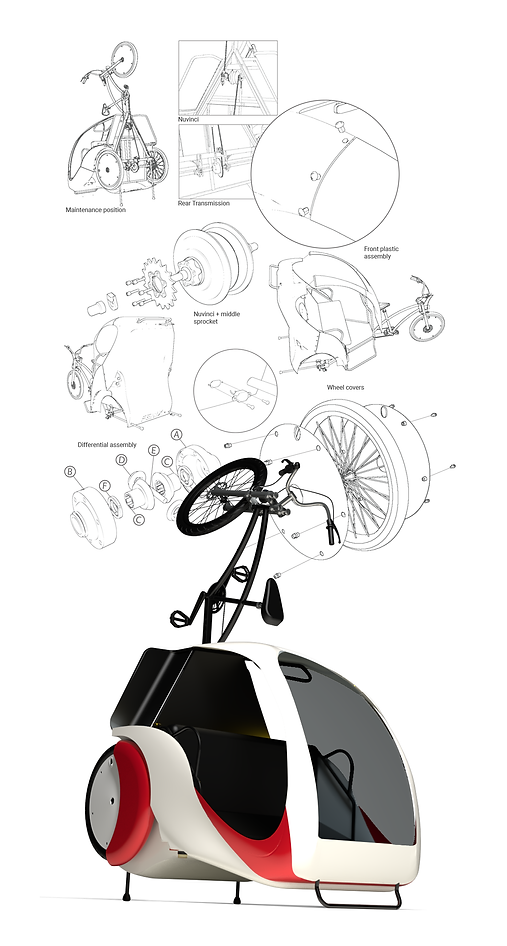
During the product development, multiple documents with high detailed graphics were required.
Besides the documents supporting the construction of frames, I worked on manuals for maintenance, use, and assembly of the components to support processes after shipping.
Construction
Once our workshop was ready, we conducted multiple reverse engineering processes on numerous frames, components, and spare parts.
I simultaneously built refined CAD models ( Alias Studio) to start constructing sample frames and prototypes.
Additionally to the CAD models, I was in charge of delivering documentation according to the requirements of multiple allies who developed pieces and components.
Exhibition
After the testing process of the prototype, I supported a pilot production of 60 samples that were shipped to Europe.
After one year of testing in multiple scenarios, I conducted interviews with our product testers to identify flaws and re-design the definitive version of our products.
In 2013 I came back to China to assist in building the prototypes 2.0 and organizing an official release of the Citytrikes products at the international shanghai fair of bikes and components.


What I Learned
Despite the project's complexity in terms of product development, production processes, and timeframe, getting involved with international and multicultural teams was the most valuable aspect of the project.
I got insights into the complexity of urban mobility; I learned a lot about cutting, welding, and plastic molding.
However, I believe that the factors that materialized the project and its success was the synchronicity and good vibe on our team.
ICar-0
Introduction

The product
After the success of the trikes on different points of Europe, the company decided to explore more alternative vehicles to enrich their offer.
The project ICARO transferred what we learned about framing and trike components to generate a small two-seated vehicle powered by an electric motor.
On the other hand, one of the main guidelines of this exploration was the necessity of using the DNA of the previous projects to define the form language.
The Problem
The micro-mobility market offers a wide range of vehicle options; however, many variations on the pedal propelling side are dependent on weather conditions because the driver tends to be exposed.
On the other hand, vehicles with more complex technological packages like the Renault Twizy jump to the opposite side, leaving an exciting range to experiment with pedal vehicle components and e-assistance.
The goal
Through the use of components and construction process implemented during the project Fenix, the main goal was to develop a concept of a small two-seated vehicle, able to take advantage of biking infrastructure in the cities.

Responsabilities
I developed Competitive audit, Exterior Design, Rough representations of the frame and its component assembly, Product brochures, Hero Images, Campaign Simulations, development of content for Crowdfunding documentation.

